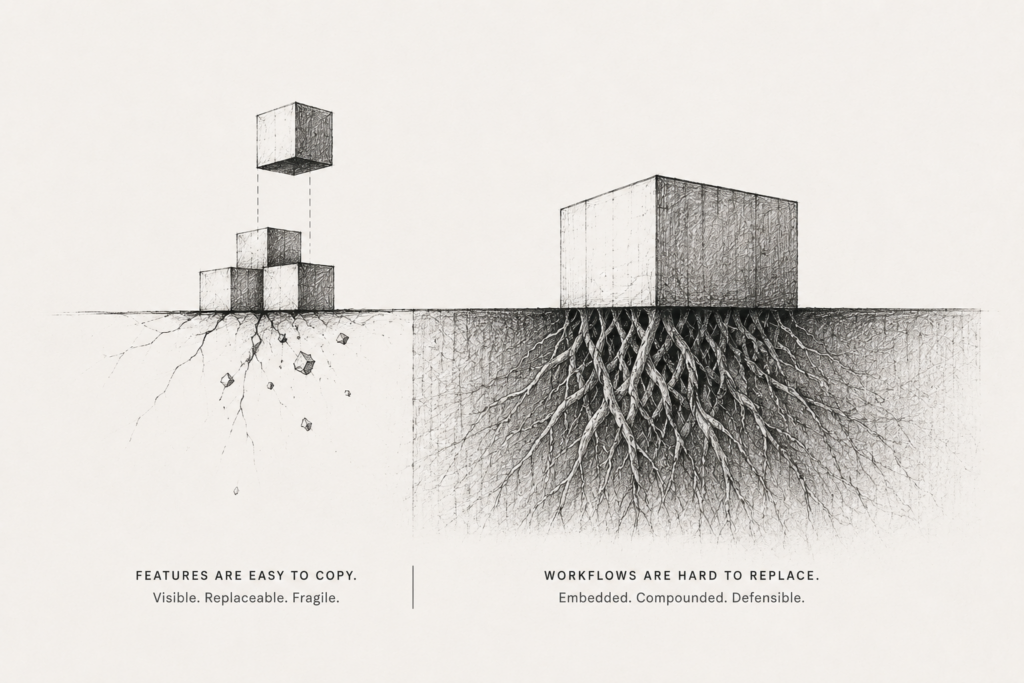
Many software companies overestimate the durability of features.
A feature may attract attention.
It may improve conversion.
It may generate excitement in the market.
But features alone rarely create long-term defensibility.
Because in modern software markets—especially AI markets—features spread quickly.
Interfaces converge.
Capabilities replicate.
Interaction patterns normalize.
And competitors absorb visible innovation faster than most companies expect.
This creates a difficult reality:
what users notice first is often the easiest thing for the market to copy.
Meanwhile, the forms of differentiation that sustain value over time are usually much less visible.
They emerge through:
- workflow integration
- operational dependence
- organizational adaptation
- accumulated context
- process coordination
- governance infrastructure
- and embedded system behavior
In other words:
workflow embedding.
Features Exist at the Surface Layer
Most buyers initially evaluate products through:
- demos
- interfaces
- visible outputs
- workflows
- and isolated capabilities
This is understandable.
Visible features are easier to compare than underlying systems architecture.
But visible capability creates a dangerous illusion:
that products compete primarily through what they expose at the surface layer.
Increasingly, they do not.
As categories mature, surface features tend to standardize surprisingly quickly.
Especially in AI markets where:
- foundation models improve broadly
- interaction paradigms spread rapidly
- open-source ecosystems evolve aggressively
- and adjacent platforms continuously absorb new functionality
This compresses visible differentiation.
Which means sustainable advantage increasingly shifts deeper into the operational system surrounding the work itself.
Workflow Embedding Changes Buyer Behavior
One of the strongest forms of defensibility in software is becoming embedded inside:
- how work gets done
- how teams coordinate
- how decisions get made
- how systems interact
- and how organizations operationalize process
Once software becomes integrated into operational behavior, it stops functioning as an isolated tool.
It becomes part of the organizational environment itself.
That changes the economics of substitution completely.
Because replacing the product no longer means replacing:
- a feature
or: - a UI
It means disrupting:
- workflows
- coordination patterns
- institutional habits
- operational dependencies
- governance structures
- integrations
- and accumulated organizational adaptation
At that point, switching cost becomes systemic rather than transactional.
That is a fundamentally different category of defensibility.
Embedded Systems Compound Over Time
Many software products become more valuable as:
- usage expands
- organizational knowledge accumulates
- integrations deepen
- policies mature
- workflows standardize
- historical context grows
- and operational reliance increases
This creates compounding leverage.
The value is no longer isolated to:
“What can the software do?”
It becomes:
“How deeply has the software become intertwined with organizational execution?”
This is particularly important in enterprise AI markets.
The strongest long-term platforms will likely not be the ones with isolated feature advantages alone.
They will be the systems that:
- integrate deeply into workflows
- accumulate organizational context
- coordinate across environments
- govern operational behavior
- and become increasingly difficult to disentangle from day-to-day execution
That kind of embedding compounds defensibility over time.
This Is Why Infrastructure Companies Become Durable
Some of the most defensible software companies in history were not initially perceived as “exciting products.”
They became durable because they embedded themselves deeply into operational systems.
Infrastructure behaves differently from tooling.
Tools can often be swapped.
Infrastructure becomes harder to remove because other systems begin depending on it.
Over time:
- workflows organize around it
- operational assumptions form around it
- processes integrate with it
- and organizational behavior adapts to its presence
The product stops being evaluated feature-by-feature.
It becomes part of the environment.
This transition is strategically significant.
Because markets frequently underestimate how defensibility emerges operationally rather than cosmetically.
AI Markets Are Moving Toward Operational Embedding
Many AI products today still compete heavily through visible capability:
- generation quality
- interface design
- automation speed
- reasoning demos
- interaction patterns
But those advantages alone are unlikely to remain stable indefinitely.
As the ecosystem matures, differentiation will increasingly emerge from:
- organizational integration
- workflow orchestration
- governance systems
- operational memory
- execution coordination
- context infrastructure
- deployment flexibility
- and system-level interoperability
In other words:
embedded operational leverage.
The companies that sustain durable advantage will likely be the ones that become deeply integrated into how organizations actually operate—not merely how users interact with isolated AI features.
Defensibility Is Often Organizational, Not Technical
One of the most important strategic shifts in modern software markets is understanding that defensibility frequently emerges from organizational integration rather than isolated technical novelty.
A product becomes difficult to substitute when:
- teams rely on it operationally
- workflows adapt around it
- systems integrate into it
- governance forms around it
- and institutional behavior evolves with it over time
At that point, replacing the product introduces:
- coordination disruption
- organizational friction
- retraining cost
- operational risk
- and process instability
That is much harder to commoditize than a standalone feature.
The Strongest Systems Become Part of the Workflow Fabric
Markets often reward visible innovation first.
But durable advantage usually belongs to products that become embedded deeply enough that removing them becomes operationally expensive, organizationally disruptive, or strategically undesirable.
This is why workflow embedding matters more than features.
Features attract attention.
Embedded systems sustain leverage.
And over time, the products that become part of the workflow fabric itself are often the ones that survive ecosystem evolution long after isolated feature advantages disappear.