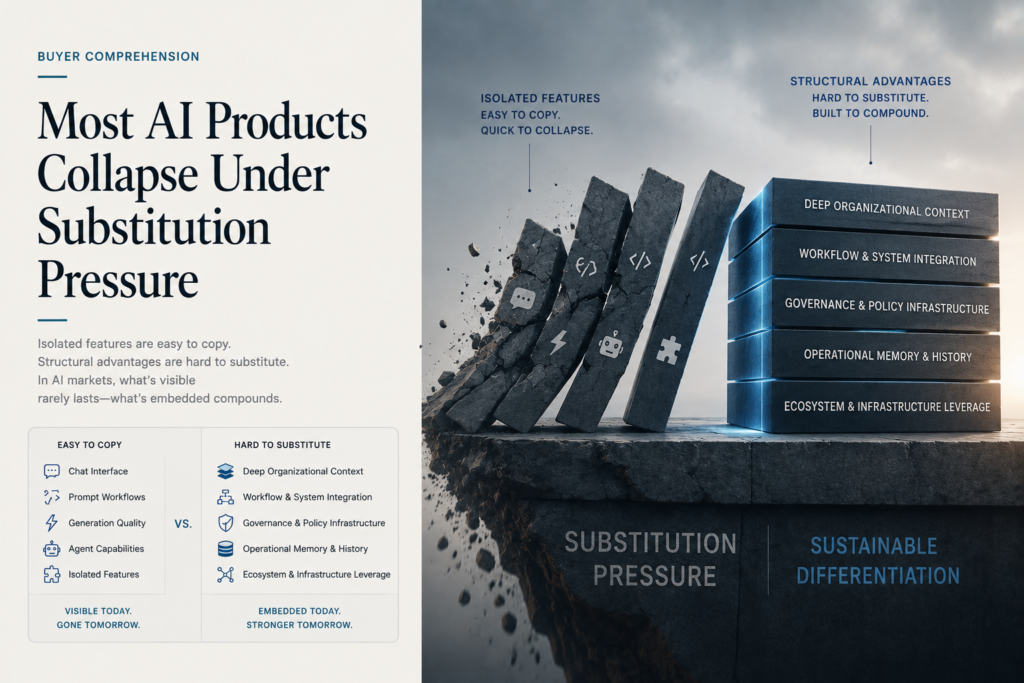
One of the defining characteristics of modern AI markets is how quickly differentiation collapses.
A company launches with a seemingly unique capability.
The market reacts.
Competitors respond.
Model providers evolve.
Adjacent platforms absorb the feature.
And within months, what once appeared strategically differentiated starts looking increasingly interchangeable.
This creates enormous confusion for technical companies.
Especially those building products with genuinely sophisticated architectures underneath them.
Because many teams assume:
“If the capability is impressive enough, differentiation will sustain itself.”
Increasingly, that is no longer true.
In AI markets, isolated capability advantages decay extremely quickly.
The Market Is Moving Faster Than Product Narratives
One reason differentiation collapses so quickly is that foundational AI capability is improving across the entire ecosystem simultaneously.
New models become broadly accessible.
Infrastructure becomes standardized.
Frameworks mature.
Open-source alternatives emerge.
Adjacent platforms expand horizontally.
As a result:
- features spread rapidly
- interaction patterns converge
- workflows begin looking similar
- and buyers struggle to distinguish between products at the surface layer
This creates substitution pressure.
The market begins asking:
- “Couldn’t another platform do this too?”
- “Isn’t this becoming table stakes?”
- “Why couldn’t the model providers themselves add this?”
- “Won’t this just become part of the ecosystem?”
These are strategically important questions.
Because they reveal whether differentiation is:
structural
or:
merely temporary implementation advantage.
Surface Similarity Hides Structural Difference
Many AI products now appear superficially similar:
- chat interfaces
- copilots
- agents
- orchestration layers
- workflow systems
- code assistants
- reasoning engines
At the interaction layer, the differences can appear subtle.
But underneath, the architectures may differ dramatically:
- deployment flexibility
- governance infrastructure
- organizational context depth
- workflow integration
- operational visibility
- retrieval architecture
- coordination systems
- execution models
- memory systems
- policy enforcement
- ecosystem integration
The problem is that buyers often evaluate products from the visible layer first.
Which means structurally different systems frequently get interpreted as:
feature-adjacent alternatives.
This is where substitution pressure becomes dangerous.
Because once products collapse into the same buyer category, the market begins evaluating them primarily through:
- convenience
- cost
- familiarity
- ecosystem gravity
- or incumbent trust
rather than structural advantage.
AI Markets Punish Isolated Features
Many early AI products differentiated through:
- prompting workflows
- generation quality
- isolated automation
- interface innovation
- or single-model capability advantages
But those advantages often proved fragile.
Why?
Because isolated features are relatively easy for:
- larger platforms
- ecosystem providers
- incumbents
- model vendors
- or adjacent products
to absorb over time.
This is one reason AI markets currently feel unstable.
The ecosystem is compressing standalone features faster than many companies anticipated.
Which means sustainable differentiation increasingly emerges from:
- systems integration
- workflow embedding
- organizational memory
- governance
- operational leverage
- proprietary context
- ecosystem positioning
- and infrastructure depth
Those are much harder to substitute.
Structural Differentiation Compounds Over Time
One of the most important strategic distinctions in AI markets is the difference between:
visible capability
and:
embedded operational advantage.
Visible capabilities attract attention.
Embedded advantages sustain defensibility.
For example:
- organizational context compounds
- workflow integration deepens
- governance systems become operationally critical
- accumulated data creates leverage
- coordination infrastructure becomes harder to replace
- organizational adoption increases switching cost
These advantages are less dramatic in demos.
But far more durable strategically.
This is often where technically sophisticated AI products derive their true defensibility.
Not from isolated generation quality.
But from becoming increasingly embedded inside the operational systems surrounding the work itself.
Buyers Still Need Interpretable Differentiation
One challenge for technically differentiated AI products is that structural advantages are often difficult to communicate clearly.
The architecture may genuinely create:
- higher quality outcomes
- lower operational risk
- stronger governance
- better scalability
- more reliable coordination
- or more durable workflow integration
But buyers may still simplify the category into:
“another AI assistant.”
This creates a dangerous disconnect.
Because the company experiences differentiation operationally, while the market experiences similarity cognitively.
That gap is where commoditization pressure accelerates.
Strong positioning helps buyers understand:
- why the architecture matters
- where existing approaches break down
- why operational outcomes diverge over time
- and why the product becomes harder—not easier—to substitute as adoption deepens
The Future Belongs to Systems, Not Features
As AI markets mature, many standalone capabilities will commoditize faster than expected.
The companies that sustain durable differentiation will likely be the ones building:
- infrastructure
- organizational systems
- workflow coordination layers
- governance environments
- operational memory
- ecosystem leverage
- and context-rich architectures
In other words:
systems that become more valuable as organizational complexity increases.
Those forms of differentiation are harder to copy because they emerge from:
- accumulated integration
- operational embedding
- organizational adaptation
- and compounded contextual understanding over time
That is fundamentally different from feature-level novelty.
Differentiation Must Survive Ecosystem Evolution
The real strategic question in AI markets is not:
“Is this capability impressive today?”
It is:
“Will this remain difficult to substitute as the ecosystem evolves?”
That is a much harder standard.
Because ecosystems evolve quickly.
Models improve quickly.
Platforms expand quickly.
Categories collapse quickly.
And products that rely primarily on isolated visible capability often discover that market differentiation disappears long before technical sophistication does.
The strongest AI companies will not simply build features the market notices.
They will build systems the market becomes increasingly dependent on over time.