methodology
The Strategic Positioning Ikigai
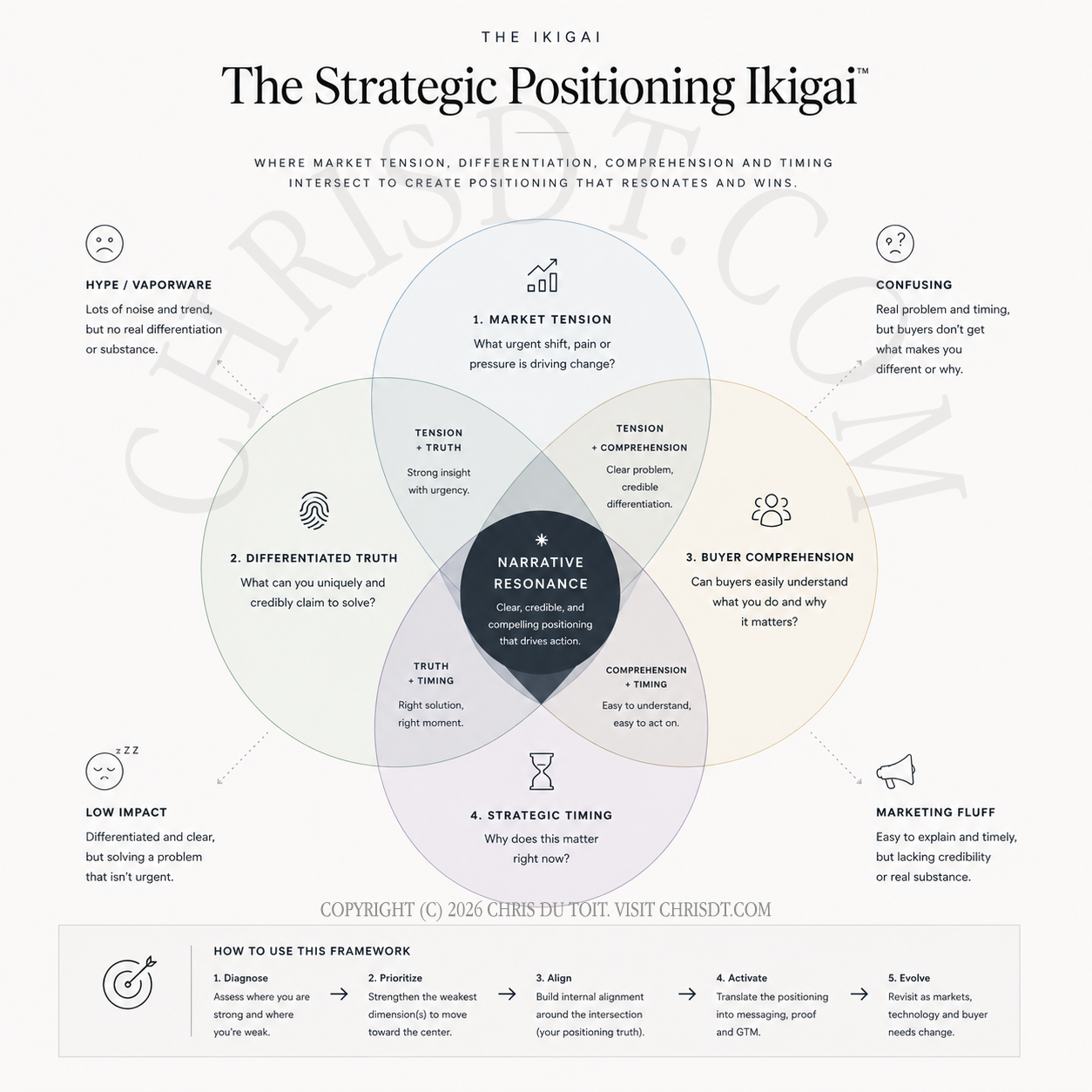
Most positioning problems aren’t messaging problems. They’re alignment problems between markets, products, timing, differentiation, and buyer understanding.
The Strategic Positioning Ikigai is a framework for diagnosing those tensions – and building positioning that compounds over time.
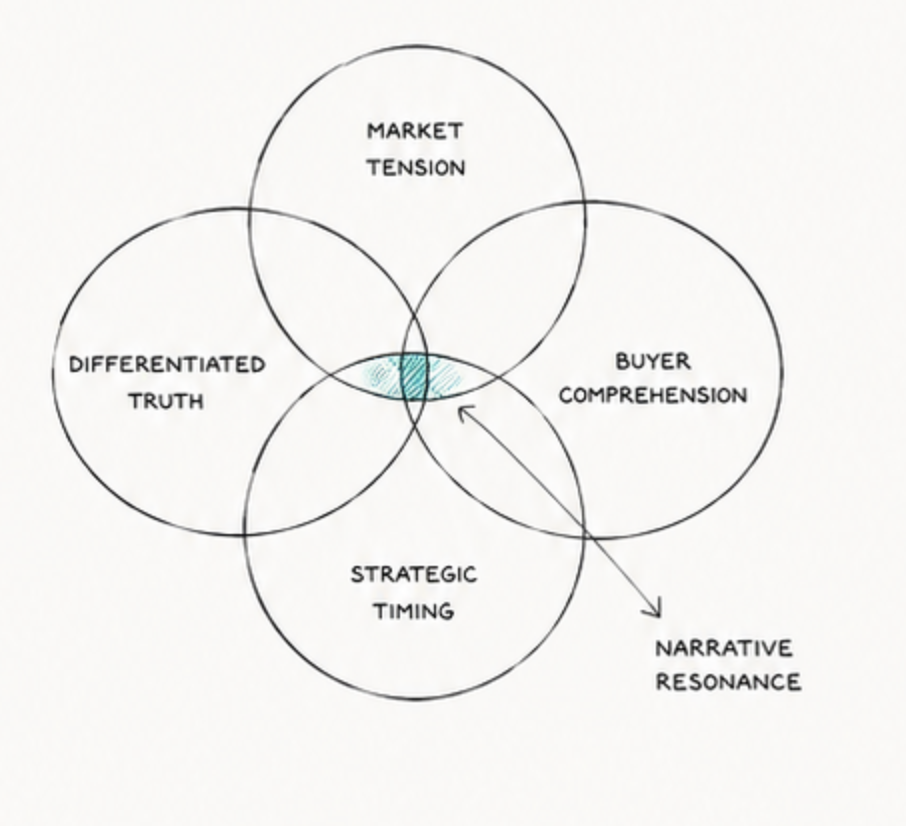
The Four Dimensions
Four dimensions. One intersection.
Individually, each dimension matters. But durable positioning emerges where they meet—at the center.
Market Tension
Many companies position around features, capabilities, or ideal customer profiles.
But markets rarely move because technology exists.
They move because pressure exists.
Market tension is the operational, organizational, economic, or strategic pressure that makes change feel necessary. Strong positioning aligns with pressure already building inside the market rather than trying to manufacture urgency through messaging alone.
Without meaningful tension, even differentiated products struggle to generate momentum.
Differentiated Truth
Many products claim differentiation.
Far fewer possess differentiation that remains credible under scrutiny.
Differentiated truth refers to the structural advantages that make a company difficult to substitute, imitate, or collapse into broader market noise.
The framework intentionally separates perceived differentiation from structurally defensible differentiation.
Because markets eventually pressure-test both.
Strong positioning does not exaggerate differentiation.
It clarifies differentiation that already exists.
Buyer Comprehension
Buyers rarely evaluate new products objectively.
They interpret them through existing mental models and familiar categories long before they fully understand how the product actually works.
Buyer comprehension is the market’s ability to understand, contextualize, and build confidence around a product and its positioning.
This is especially important in AI markets where technical complexity often exceeds buyer comprehension bandwidth.
Many positioning failures are not failures of product quality.
They are failures of interpretability.
Strategic Timing
Even strong positioning can fail when market conditions are misaligned.
Strategic timing refers to the broader environmental conditions that shape whether the market is ready to absorb, prioritize, and operationalize a new category or architectural shift.
Timing matters because buyers do not evaluate products in isolation.
In many emerging markets, the problem is not that products arrive too late.
It is that comprehension infrastructure arrives too slowly.
At the center is
Narrative Resonance.
The point where meaningful pressure exists, differentiation is credible, buyers can understand the value, and timing aligns with the broader environment. This is where positioning begins to compound.
My Approach
A different way of approaching positioning
Over time I developed a more systems-oriented way of approaching positioning, category strategy, and product narrative for complex technical products.
The methodology starts from a simple observation: most companies try to improve messaging after confusion already exists in the market. But by that point, buyers are often struggling with something deeper. They don’t yet have a stable mental model for what the product is, where it fits, or why the underlying shift matters enough to change behavior.
That changes the nature of the problem entirely.
Instead of treating positioning as a copywriting exercise, the methodology looks at how products become understood across the full system: the category they are compared against, the operational change they introduce, the assumptions buyers bring into the conversation, the language teams use internally, and the narratives the market naturally collapses toward when complexity increases.
The goal is not simply clearer messaging.
It’s creating alignment between technical differentiation, market understanding, and commercial momentum — so the product becomes easier to adopt, easier to explain, and harder to miscategorize as the market evolves around it.
Work Together
Let’s bring clarity to complex problems.
Some companies engage around a specific positioning or category problem. Others bring me in more deeply to help align product narrative, executive communication, go-to-market strategy, and market understanding as the company evolves.
The workshop format is typically used to surface:
* market tension
* differentiated truth
* buyer comprehension
* strategic timing
* and the narrative intersections between them
For companies navigating larger transitions, I also work in an ongoing advisory or fractional leadership capacity where the methodology becomes part of a broader strategic and commercial operating model.
The work is intentionally collaborative, systems-oriented, and grounded in helping technically differentiated products become easier for the market to understand, adopt, and advocate for over time.
