I help technical companies make sense of complexity and act on what actually matters
Modern software products are becoming more technically differentiated while simultaneously becoming harder for the market to understand, position, and adopt.
I work with companies navigating that transition across AI, developer platforms, enterprise software, and emerging technical categories where older market language and mental models no longer fully explain what the product actually is.
Chris du Toit
Strategic operator focused on how modern technical products are understood, categorized, and adopted.
Current observation:
The technology is evolving faster than the language used to explain it. I take technical products to market such as:
- AI systems
- developer platforms
- API Management
- emerging product categories

The hardest part isn’t building something powerful.
It’s making it understood…
THE PATTERN
Most Technical Products Become Harder to Explain as They Become More Differentiated
Especially in markets shaped by AI, developer platforms, infrastructure, automation, and emerging software architectures.
The technology evolves quickly.
The market understanding usually doesn’t.
That gap creates more than messaging problems. Products that should stand apart start sounding interchangeable. Sales cycles become educational. Positioning gets unstable. Teams compensate by adding more language, more architecture, and more explanation.
The understanding rarely improves.

Experience
Where I’ve been and what I’ve learned.
-
CMO – Tabnine, inc
At Tabnine, I led the transformation of the company’s market position from AI coding assistant to enterprise AI agent platform. Working at the intersection of AI, developer tooling, and enterprise software, I helped establish a new narrative around context-aware agents, governance, and trusted AI adoption. The work included launching the Enterprise Context Engine, securing Gartner Visionary recognition, shaping competitive strategy against emerging AI agent platforms, and building a go-to-market motion designed to help large enterprises move from AI experimentation to operationalization.
-
CMO – Gravitee.io
At Gravitee, I spent four years helping transform a technically sophisticated platform into a category leader. Working across API Management, Event Streaming, and AI, I led the company’s positioning, go-to-market strategy, and market education efforts through multiple stages of growth, contributing to more than 80% annual revenue growth and Gravitee’s rise from an unranked vendor to a Gartner Magic Quadrant Leader. The experience reinforced a lesson that would later shape much of my thinking: technical superiority alone rarely creates market success. Markets need a way to understand why a product matters, how it is different, and why it deserves attention now.
-
CMO – Kobiton, inc
At Kobiton, I helped scale an AI-driven mobile testing platform from an emerging startup into a recognized leader in the test automation space. Over four years, the company grew from roughly $250,000 to nearly $14 million in annual recurring revenue while expanding through both organic growth and acquisition. My role spanned positioning, pricing, demand generation, team building, and market education, including authoring a book on Appium-based test automation. The experience deepened my appreciation for the role understanding plays in technology adoption—particularly in markets where technical innovation must first overcome entrenched workflows and established assumptions before it can create meaningful change.
-
CMO & CPO – Jacada, Inc
My time at Jacada marked the beginning of a career-long fascination with how markets adopt new technology. As Chief Marketing and Product Officer, I led product strategy and marketing for a portfolio that included conversational AI, chatbots, visual IVR, conversational commerce, and robotic process automation long before many of these categories entered the mainstream. Over fourteen years, I launched new products, developed intellectual property, built market awareness, and worked closely with customers to understand how emerging technologies move from novelty to necessity. Looking back, many of the themes explored in The Understanding Gap first appeared during this period: buyers struggling to evaluate unfamiliar technologies, markets lacking the language to describe what was changing, and companies needing to bridge the gap between technical innovation and customer understanding.
-
Software Engineering – Various
My career began on the other side of the table—as a software developer, architect, engineering leader, and founder. Over more than a decade, I built enterprise software, led development teams across multiple continents, and founded a technology consulting firm focused on large-scale web and enterprise systems. That experience gave me a deep appreciation for the realities of building technology, not just marketing it. It also explains why much of my work today sits at the intersection of product, engineering, and go-to-market strategy. I’ve spent as much time understanding how technology works as I have understanding how markets learn to value it.
My Approach
A different way of approaching positioning
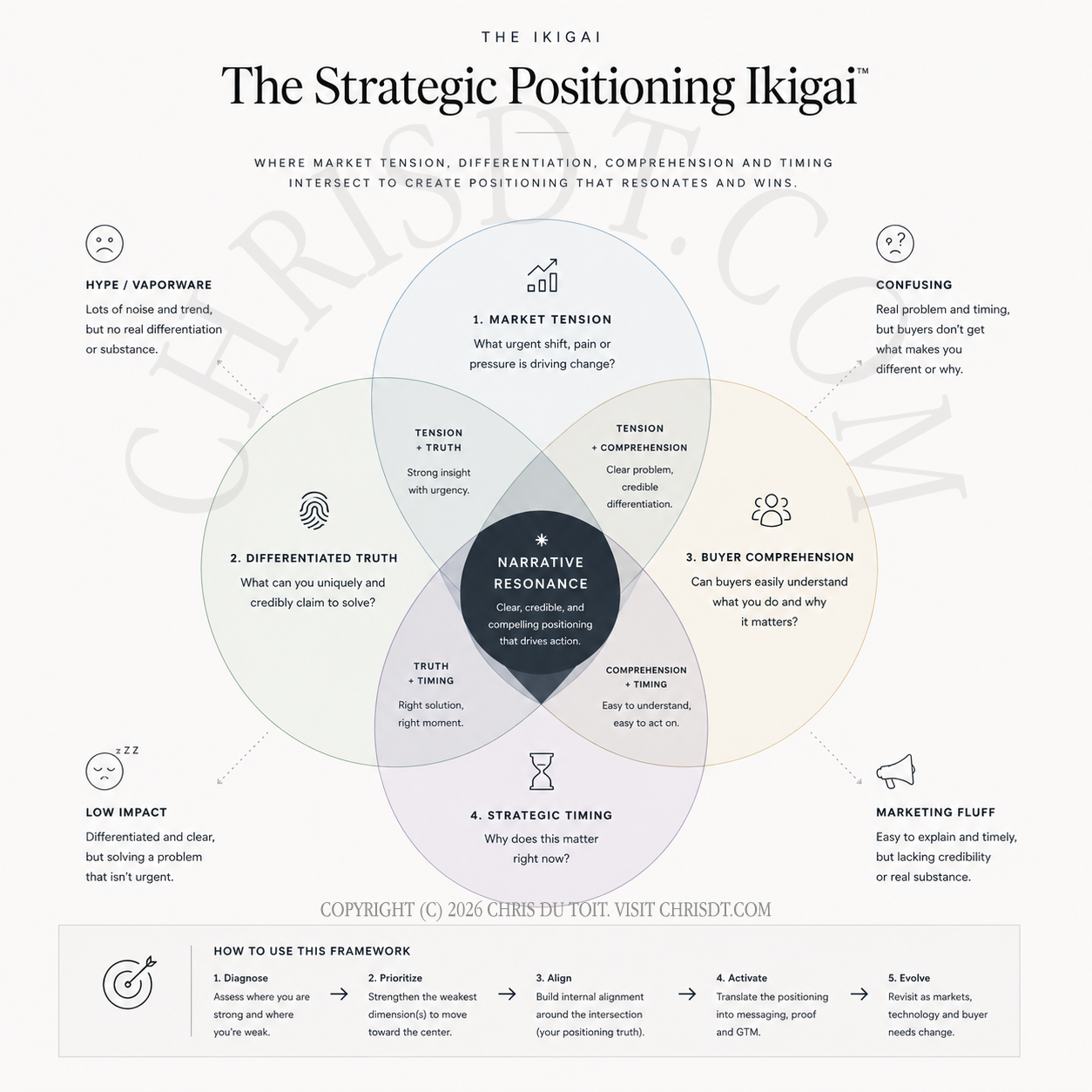
Over time I developed a more systems-oriented way of approaching positioning, category strategy, and product narrative for complex technical products.
The methodology starts from a simple observation: most companies try to improve messaging after confusion already exists in the market. But by that point, buyers are often struggling with something deeper. They don’t yet have a stable mental model for what the product is, where it fits, or why the underlying shift matters enough to change behavior.
That changes the nature of the problem entirely.
Instead of treating positioning as a copywriting exercise, the methodology looks at how products become understood across the full system: the category they are compared against, the operational change they introduce, the assumptions buyers bring into the conversation, the language teams use internally, and the narratives the market naturally collapses toward when complexity increases.
The goal is not simply clearer messaging.
It’s creating alignment between technical differentiation, market understanding, and commercial momentum — so the product becomes easier to adopt, easier to explain, and harder to miscategorize as the market evolves around it.
