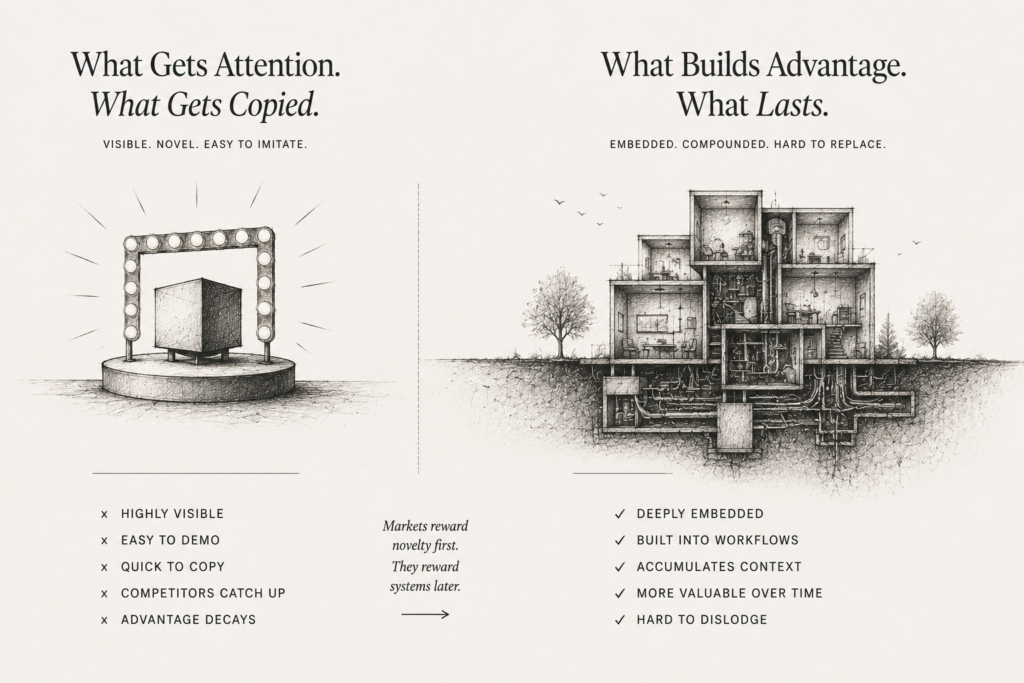
Markets are naturally attracted to visible innovation.
New interfaces.
New workflows.
New capabilities.
New demos.
New interaction patterns.
The products that generate the most excitement early are often the ones that appear dramatically different at the surface layer.
This makes sense.
Novelty is easy to notice.
But many of the most durable forms of differentiation do not initially look dramatic at all.
In fact, they often look:
- incremental
- infrastructural
- operational
- constrained
- unglamorous
- or even unnecessarily complicated
Because durable differentiation usually emerges from systems—not spectacle.
Markets Notice What Is Visible
Early market attention tends to reward:
- visible capability
- interface innovation
- dramatic demos
- immediate output quality
- automation theater
- and easily communicable novelty
These things spread quickly because they are:
- easy to understand
- easy to compare
- easy to share
- and easy to explain internally
But visibility is not the same thing as defensibility.
Many highly visible advantages decay rapidly once:
- competitors imitate them
- ecosystems absorb them
- platforms standardize them
- or buyer expectations normalize
This is especially true in AI markets where capability diffusion happens extremely quickly.
The market often mistakes:
attention
for:
durability.
Those are not the same thing.
Durable Systems Compound Quietly
Many of the strongest long-term advantages emerge slowly through:
- workflow integration
- organizational adaptation
- infrastructure depth
- accumulated context
- operational memory
- governance maturity
- deployment flexibility
- ecosystem integration
- and coordination leverage
These advantages rarely create dramatic launch moments.
Instead, they compound gradually over time.
The value becomes visible later because the advantage emerges through:
- reliability
- scalability
- operational coherence
- organizational dependence
- and increasing difficulty of substitution
This kind of differentiation is often underestimated early because it does not immediately produce obvious spectacle.
But structurally, it is much harder to replace.
Infrastructure Rarely Looks Exciting Early
Some of the most strategically important software categories historically looked relatively unremarkable at first.
Infrastructure often appears:
- overly technical
- operationally narrow
- excessively architectural
- or less exciting than application-layer innovation
But infrastructure behaves differently over time.
Once systems begin depending on it:
- workflows organize around it
- integrations accumulate
- operational assumptions stabilize
- and switching cost compounds
At that point, the product stops functioning as a feature set and starts functioning as operational substrate.
That transition is strategically significant.
Because the most durable companies are often the ones that become woven into how organizations actually operate—not simply how they experiment.
AI Markets Currently Over-Reward Surface Innovation
Modern AI markets are still heavily influenced by:
- visible demos
- interaction novelty
- benchmark performance
- generation quality
- interface experimentation
- and rapid iteration cycles
This creates an environment where:
- visible capability receives disproportionate attention
- while structural advantage remains harder to recognize early
As a result, many companies optimize for:
- appearing advanced
instead of: - becoming operationally indispensable
But as markets mature, buyer priorities usually evolve.
Organizations eventually begin caring more about:
- reliability
- governance
- interoperability
- operational consistency
- deployment flexibility
- coordination
- and system integration
That is often where durable differentiation starts separating from temporary novelty.
The Strongest Advantages Often Feel Obvious in Retrospect
One reason durable differentiation gets underestimated early is that compounded systems often appear inevitable after they mature.
Once infrastructure becomes deeply embedded, people retroactively assume the advantage was always obvious.
But early on, many durable systems looked:
- slower
- less polished
- less exciting
- or strategically narrower than more visible alternatives
The market tends to underestimate:
compounding operational leverage.
Especially when compared against:
immediate visible novelty.
This creates opportunities for companies willing to optimize for long-term defensibility rather than short-term excitement alone.
Real Differentiation Changes System Behavior
One of the strongest indicators of durable differentiation is whether the product changes how organizations actually operate.
Not temporarily.
Not cosmetically.
But structurally.
Does it:
- reshape workflows?
- alter coordination patterns?
- become embedded in execution?
- accumulate operational context?
- improve organizational coherence?
- create infrastructure dependency?
- deepen over time?
If the answer is yes, the differentiation is likely emerging at the systems layer rather than the feature layer.
That kind of advantage compounds differently.
Because systems become more valuable as organizational complexity increases.
Markets Eventually Converge Toward Operational Reality
Early markets often reward novelty.
Mature markets tend to reward reliability, integration, and operational leverage.
Over time, categories usually compress around:
- what scales
- what integrates
- what compounds
- and what organizations become dependent on operationally
That transition is important.
Because it means the products generating the most excitement early are not always the ones building the strongest long-term position.
Durable differentiation frequently looks quieter at first because the advantage is accumulating beneath the surface layer before the market fully recognizes its significance.
And by the time the market does recognize it, the system is often already deeply embedded.