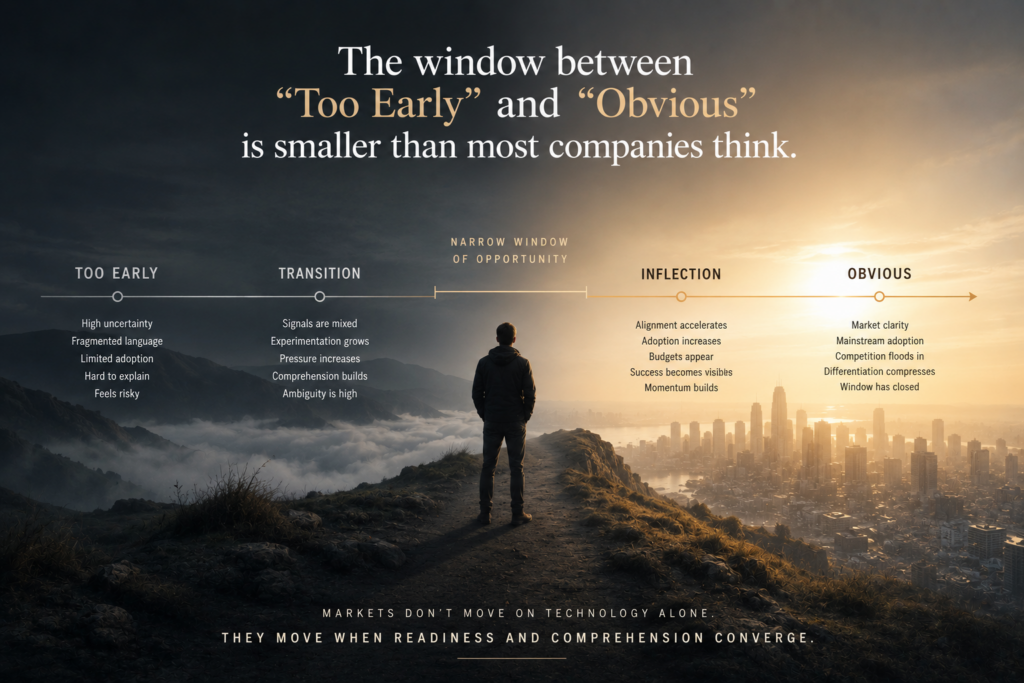
Most emerging markets feel impossible right before they become inevitable.
That transition is difficult to recognize in real time because categories rarely evolve linearly.
For long periods, the market appears:
- fragmented
- confusing
- inconsistent
- immature
- or commercially uncertain
Then suddenly:
- budgets appear
- competitors flood the market
- executive urgency accelerates
- organizational adoption increases
- and the category begins behaving as though it was obvious all along
This creates one of the most dangerous timing mistakes companies make:
assuming they have more time than they actually do.
Markets Often Transition Gradually Then All At Once
Most category shifts spend years accumulating pressure invisibly underneath the surface.
During this phase:
- workflows weaken slowly
- operational complexity compounds
- ecosystem infrastructure matures
- organizational discomfort increases
- and buyer comprehension gradually improves
But because the changes happen incrementally, the market still appears unstable externally.
Then a threshold gets crossed.
The surrounding conditions begin aligning simultaneously:
- the technology matures
- operational pain becomes visible
- trust improves
- workflows stabilize
- governance emerges
- and organizations finally develop enough comprehension to operationalize adoption coherently
At that point, market behavior changes rapidly.
What felt “too early” suddenly becomes:
strategically urgent.
Most Companies Misread Transitional Markets
One reason timing is so difficult is that transitional markets produce contradictory signals.
Companies see:
- strong interest but weak conversion
- executive excitement but organizational hesitation
- experimentation without scaled adoption
- growing usage but unstable budgets
- fragmented language but increasing urgency
This ambiguity causes many organizations to delay commitment.
They interpret instability as evidence that the market is still far away.
But often:
the instability itself is evidence that the transition is already underway.
The category is forming faster than the market’s language and operational structures can stabilize around it.
The Most Dangerous Moment Is Usually Right Before Consensus Forms
Once a category becomes obvious broadly:
- positioning advantages narrow
- differentiation compresses
- incumbents respond aggressively
- ecosystem competition increases
- and market expectations standardize quickly
This means many of the strongest strategic opportunities exist during the uncomfortable intermediate phase where:
- the market is real
- but consensus is incomplete
That window is psychologically difficult for most organizations.
Because investing heavily before consensus exists feels risky.
But waiting until consensus fully forms often means entering:
- a more crowded market
- with weaker interpretive advantage
- lower category influence
- and less strategic leverage
This is why timing matters so much.
The transition between:
“premature”
and:
“obvious”
is frequently much shorter than companies anticipate.
Buyer Comprehension Accelerates Nonlinearly
One reason category transitions suddenly accelerate is that comprehension compounds socially.
Initially:
- buyers struggle to explain the problem
- organizations lack shared language
- workflows remain experimental
- and internal alignment is weak
But over time:
- concepts stabilize
- frameworks emerge
- operational examples accumulate
- success stories spread
- and organizations begin inheriting understanding from the broader ecosystem
At that point, adoption becomes dramatically easier.
Not necessarily because the technology changed fundamentally overnight.
But because:
the cognitive cost of understanding the category dropped.
This is one reason market acceleration often appears sudden from the outside.
Shared interpretation finally catches up to operational reality.
Enterprise AI Is Approaching This Kind of Inflection Point
Many enterprise AI markets currently exhibit classic transitional characteristics:
- growing operational pressure
- fragmented terminology
- unstable categories
- rapid experimentation
- organizational uncertainty
- and increasing executive urgency
The market still feels early because:
- workflows remain immature
- governance models are evolving
- and comprehension is inconsistent
But the underlying pressure environment is intensifying quickly:
- software complexity is rising
- AI-assisted workflows are expanding
- coordination overhead is increasing
- and organizations are struggling to operationalize AI coherently at scale
Those are usually signals of:
approaching category acceleration.
Not category immaturity.
Strategic Timing Requires Tolerating Ambiguity
One of the hardest strategic capabilities is operating during periods where:
- the market is directionally inevitable
- but organizational consensus has not fully formed yet
This stage feels uncomfortable because:
- buyer behavior remains inconsistent
- positioning requires education
- categories remain unstable
- and market narratives continue shifting
Many companies retreat toward safer, more familiar positioning during this phase.
That often improves short-term comprehension.
But it can also collapse long-term category differentiation.
The companies that shape markets are usually the ones willing to tolerate temporary ambiguity long enough to position into:
the future operational reality of the market
before the category becomes fully normalized.
Categories Feel Obvious Only After They Stabilize
Looking backward, most major category transitions appear inevitable.
But in real time, they usually feel:
- noisy
- fragmented
- contradictory
- and uncertain
That uncertainty causes many organizations to move too cautiously.
Especially during the narrow window where:
- operational pressure is already real
- the ecosystem is rapidly maturing
- and buyer comprehension is approaching critical mass
By the time the category feels completely obvious, much of the strategic positioning advantage has already been claimed.
Because the distance between:
“too early”
and:
“inevitably mainstream”
is often far smaller than most companies realize while living through the transition itself.