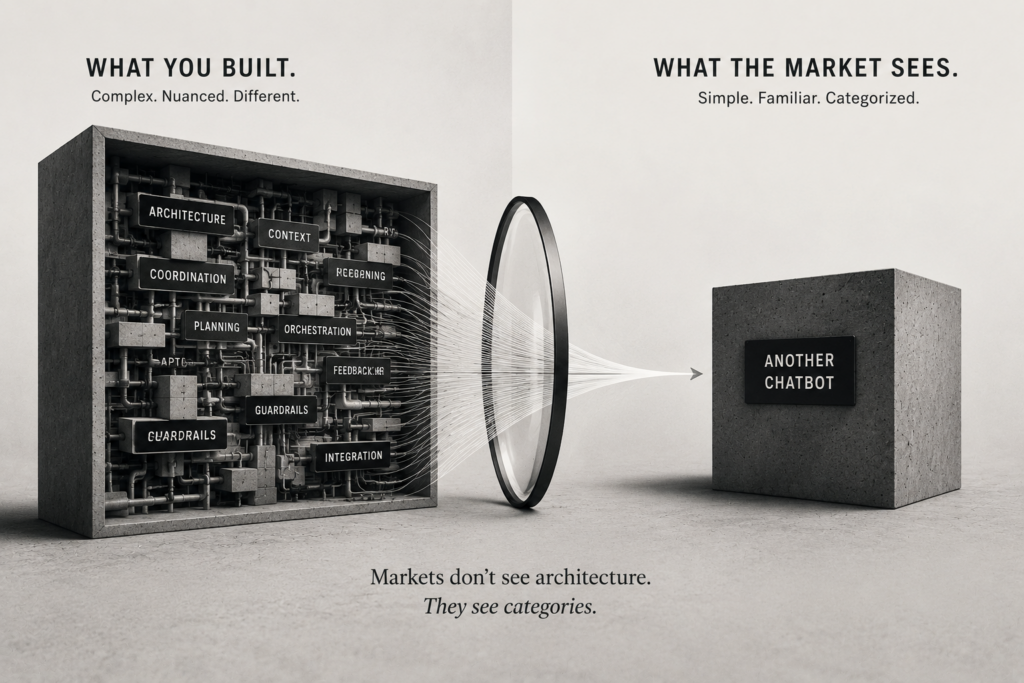
One of the most difficult realities in positioning is that companies do not fully control how the market interprets their product.
They influence it.
They guide it.
They frame it.
But markets naturally compress unfamiliar ideas into existing mental models long before they fully understand how the product actually works.
This happens constantly in emerging technology markets.
New systems rarely enter the market as entirely new categories.
Instead, they get pulled backward into older frameworks buyers already understand:
- copilots become autocomplete
- agents become chatbots
- orchestration becomes workflow automation
- context becomes search
- infrastructure becomes API management
The market simplifies first.
Understands later.
This is not a messaging failure.
It is how buyer cognition works.
Buyers Interpret Before They Analyze
Most positioning assumes buyers evaluate products rationally and sequentially.
But real market interpretation happens much faster and much more heuristically.
When buyers encounter something unfamiliar, the brain immediately searches for:
- category anchors
- familiar comparisons
- recognizable patterns
- existing frameworks
- known purchasing models
Not because buyers are unintelligent.
Because cognitive compression is efficient.
Organizations do not have the bandwidth to deeply analyze every emerging category from first principles.
So they interpret new systems through:
what already exists in memory.
That process happens before detailed technical understanding ever begins.
Categories Behave Like Gravity
Existing categories exert enormous interpretive force.
The stronger and more established the category:
- the easier it is for buyers to understand
- the easier it is for organizations to operationalize
- and the harder it becomes for genuinely new architectures to escape comparison against it
This creates what is effectively:
category gravity.
Markets naturally pull unfamiliar products toward:
- the nearest recognizable analogy
- the simplest explanation
- or the most operationally familiar interpretation
That is why genuinely new systems often get misunderstood initially.
Not because the technology lacks value.
But because buyers are attempting to reduce interpretive uncertainty.
Technical Differentiation Does Not Automatically Translate Into Buyer Understanding
This creates a major problem for technically sophisticated companies.
Especially in AI markets.
Internally, the company may understand the architecture clearly:
- how the system works
- why the design matters
- where existing approaches break down
- and why the product behaves fundamentally differently underneath
But the buyer rarely experiences architecture directly.
The buyer experiences:
- interfaces
- workflows
- outcomes
- category language
- and comparative framing
Which means products that are architecturally distinct may still appear:
superficially interchangeable.
This creates one of the central tensions in emerging markets:
the product is genuinely different, but the market lacks the interpretive framework to fully recognize the difference yet.
The Market Usually Defaults to the Simplest Story
When categories are unstable, buyers often prioritize:
- interpretability
over: - precision
This means the market tends to reward explanations that are:
- simple
- familiar
- operationally legible
- and easy to communicate internally
Even when those explanations are partially inaccurate.
This is why many companies unintentionally position themselves backward into older categories.
Because the simpler comparison:
- reduces buyer friction
- accelerates comprehension
- and lowers organizational uncertainty
But it also creates long-term risk.
Once the market firmly anchors the product inside an older category, escaping that interpretation becomes extremely difficult.
This Is Why Buyer Comprehension Matters So Much
Many positioning problems are not actually differentiation problems.
They are:
comprehension problems.
The differentiation may already exist.
The market simply does not yet possess the conceptual language to interpret it correctly.
This distinction matters enormously.
Because companies often respond to poor market understanding by:
- adding more features
- increasing technical complexity
- expanding messaging
- or broadening use cases
when the real issue is:
interpretive clarity.
The buyer cannot yet comfortably answer:
- What is this?
- Why does it matter?
- How is it different?
- Why is the architecture important?
- What category does this belong to?
- Why won’t existing systems solve this already?
Until those questions stabilize cognitively, positioning friction remains high.
Emerging Markets Are Ultimately Interpretation Battles
One of the defining characteristics of emerging categories is that the technology usually matures faster than buyer understanding.
This creates a period where:
- products exist
- capabilities are real
- operational value is emerging
- but category comprehension remains unstable
That instability creates enormous strategic opportunity.
Because the companies that shape the interpretive framework of the category often gain disproportionate long-term advantage.
Not simply by building technology.
But by helping the market understand:
- what changed
- why existing models break down
- and how the new system should actually be interpreted
That is fundamentally a comprehension problem.
Positioning Is Partly About Building New Mental Models
The strongest positioning does not merely describe products.
It helps buyers construct new frameworks for understanding the market itself.
That is especially important when:
- architectures evolve
- workflows shift
- categories blur
- and older language stops mapping cleanly onto newer systems
At that point, positioning becomes less about persuasion and more about:
interpretive guidance.
Helping the market:
- update its assumptions
- recognize new patterns
- and understand why older categories no longer fully explain what is happening
Because in emerging markets:
the companies that win are often the ones that help define how the market thinks about the category in the first place.