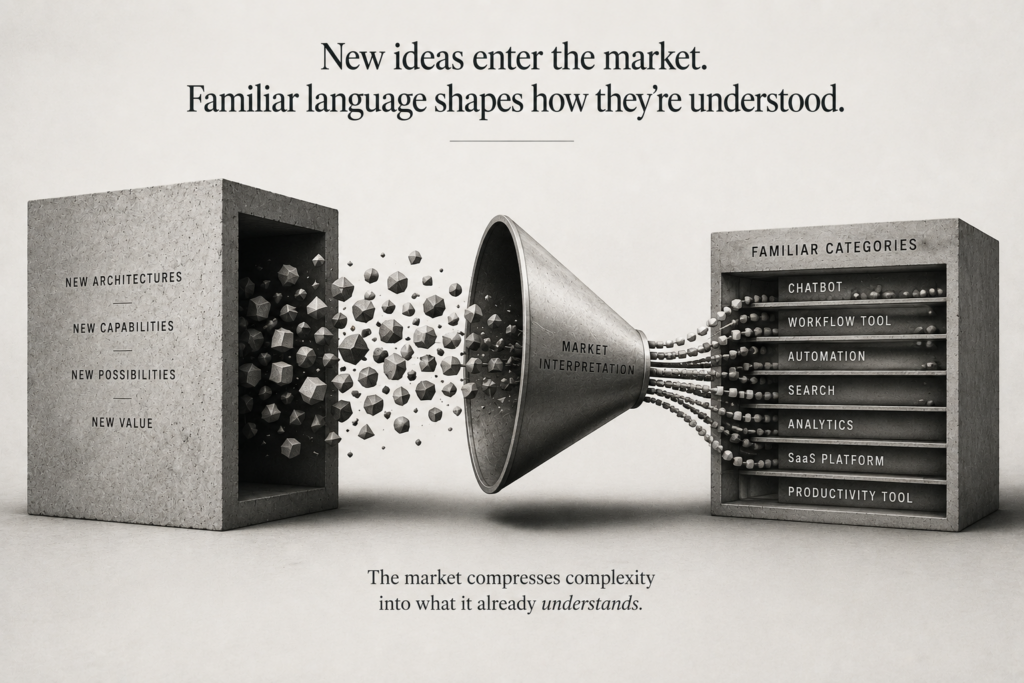
Every emerging market experiences a period where the technology evolves faster than the language used to explain it.
During that phase, buyers attempt to understand new systems using the vocabulary of older categories.
This is not accidental.
It is how markets reduce uncertainty.
When organizations encounter unfamiliar products, they instinctively search for:
- recognizable analogies
- familiar workflows
- known purchasing patterns
- existing budget categories
- and operationally understandable language
That process creates a powerful dynamic:
emerging categories get pulled backward into older conceptual frameworks.
This happens constantly in technology markets:
- cloud infrastructure became “someone else’s servers”
- DevOps became “better IT automation”
- AI agents become “chatbots”
- orchestration becomes “workflow software”
- organizational context becomes “search”
- reasoning systems become “assistants”
The language becomes familiar long before the architecture becomes understood.
Familiar Language Reduces Cognitive Cost
Organizations are designed to minimize uncertainty.
Especially large organizations.
New categories introduce friction because they require buyers to:
- rethink assumptions
- update mental models
- reinterpret workflows
- justify unfamiliar spending
- and explain new concepts internally
That is cognitively expensive.
Familiar language lowers that cost.
If a buyer can explain a product using an existing category:
- procurement becomes easier
- executive conversations become easier
- budgeting becomes easier
- internal alignment becomes easier
- and organizational risk feels lower
This is why markets often prefer:
inaccurate familiarity
over:
precise novelty.
At least initially.
Categories Behave Like Compression Algorithms
One useful way to think about categories is as:
organizational compression systems.
Categories help markets simplify complexity.
Instead of evaluating every product independently from first principles, buyers group products into recognizable conceptual buckets:
- databases
- CRMs
- workflow tools
- infrastructure platforms
- security software
- copilots
- agents
These categories create efficiency.
But they also create distortion.
Because once a market assigns a familiar label to a product, buyers begin inheriting all the assumptions associated with that category automatically.
That affects:
- expectations
- pricing assumptions
- competitive framing
- purchasing behavior
- feature interpretation
- and perceived strategic importance
This is why category anchoring matters so much.
The first stable interpretation the market adopts often becomes surprisingly durable.
New Architectures Rarely Arrive With Stable Language
One reason emerging technology markets feel confusing is that the architecture often changes before the vocabulary does.
The market may understand:
- the interface
- the output
- or the interaction pattern
while still lacking conceptual language for:
- the underlying system behavior
- coordination model
- architectural shift
- organizational implication
- or operational transformation
This creates interpretive mismatch.
For example:
an AI system that operates through:
- organizational context
- planning
- orchestration
- coordination
- memory
- governance
- and multi-step reasoning
may still get categorized as:
“another chatbot”
because chatbot is the nearest stable interpretive reference the market already understands.
That simplification is cognitively efficient.
But strategically inaccurate.
This Creates Category Gravity
Once familiar language begins stabilizing around a product category, it creates:
category gravity.
The market starts pulling adjacent products into the same interpretive framework regardless of architectural distinction.
This creates several problems:
- differentiated systems appear interchangeable
- buyers compare products incorrectly
- architectural advantages become invisible
- pricing pressure increases
- and companies begin optimizing toward category expectations instead of structural advantage
Over time, companies may even start positioning themselves backward into older categories simply because the market already understands them better.
That can accelerate adoption temporarily.
But it also risks collapsing long-term differentiation.
The Market Often Understands Outcomes Before Systems
One reason category collapse happens so consistently is that buyers typically experience:
outputs first
and:
architectures later.
For example:
two fundamentally different systems may both:
- generate code
- answer questions
- summarize information
- automate tasks
- or coordinate workflows
From the outside, they appear similar.
But underneath, the systems may differ dramatically in:
- reasoning structure
- operational context
- governance
- planning capability
- orchestration
- memory
- workflow integration
- or organizational understanding
The market frequently compresses these distinctions because:
the outcome appears familiar even when the underlying architecture is not.
Positioning Is Partly About Defending Interpretive Space
This is one reason positioning matters far beyond messaging.
Positioning is not merely describing the product.
It is helping shape:
- the interpretive framework surrounding the category itself.
The strongest companies in emerging markets often succeed not only because they build valuable systems, but because they help the market:
- update its vocabulary
- recognize new architectural patterns
- understand why older comparisons break down
- and develop more accurate mental models over time
That process takes time.
Because categories stabilize socially before they stabilize technically.
Emerging Markets Are Interpretation Battles Before They Are Technology Battles
In mature markets, buyers already understand:
- what the category is
- why it exists
- how products differ
- and what purchasing criteria matter
Emerging markets behave differently.
The primary challenge is often not capability.
It is interpretation.
The market is still trying to determine:
- what this actually is
- what category it belongs to
- how important it is
- and which older assumptions still apply
That is why emerging categories collapse into familiar language.
Not because the market is incapable of understanding novelty.
But because familiar language provides temporary stability while the market slowly develops new conceptual frameworks underneath it.