Many technical companies assume differentiation is self-evident.
The product is:
- architecturally novel
- technically sophisticated
- operationally superior
- more scalable
- more secure
- more intelligent
- or fundamentally designed differently from existing approaches
From inside the company, the differentiation feels obvious.
But markets do not evaluate products from inside the architecture.
They evaluate them through:
- existing mental models
- familiar categories
- visible outcomes
- operational relevance
- and comparative simplicity
This creates one of the most common positioning failures in modern software markets:
technical differentiation without market differentiation.
The Market Compresses Complexity
Most buyers do not have the time, context, or incentive to fully internalize architectural nuance.
So the market naturally compresses unfamiliar products into familiar categories.
This happens constantly in emerging technology markets:
- copilots become autocomplete
- agents become chatbots
- orchestration becomes workflow automation
- infrastructure becomes API management
- context becomes search
The more technically complex the product becomes, the more aggressively the market searches for familiar interpretive shortcuts.
This is not irrational behavior.
It is cognitive efficiency.
Buyers simplify first.
Understand later.
Which means technical novelty alone rarely guarantees differentiated market perception.
Products Compete Inside Buyer Interpretation Systems
One of the most important realities in positioning is that products do not compete purely at the capability layer.
They compete inside:
interpretation systems.
Meaning:
- what buyers think the product is
- how they categorize it
- what alternatives they compare it against
- and which existing mental models they use to explain it internally
This is why companies often experience a strange contradiction:
“The product is genuinely different, but the market treats it as interchangeable.”
From the market’s perspective, differentiation only exists once buyers can:
- recognize it
- explain it
- contextualize it
- and connect it to a meaningful operational advantage
Until then, even highly differentiated products tend to collapse into broader category assumptions.
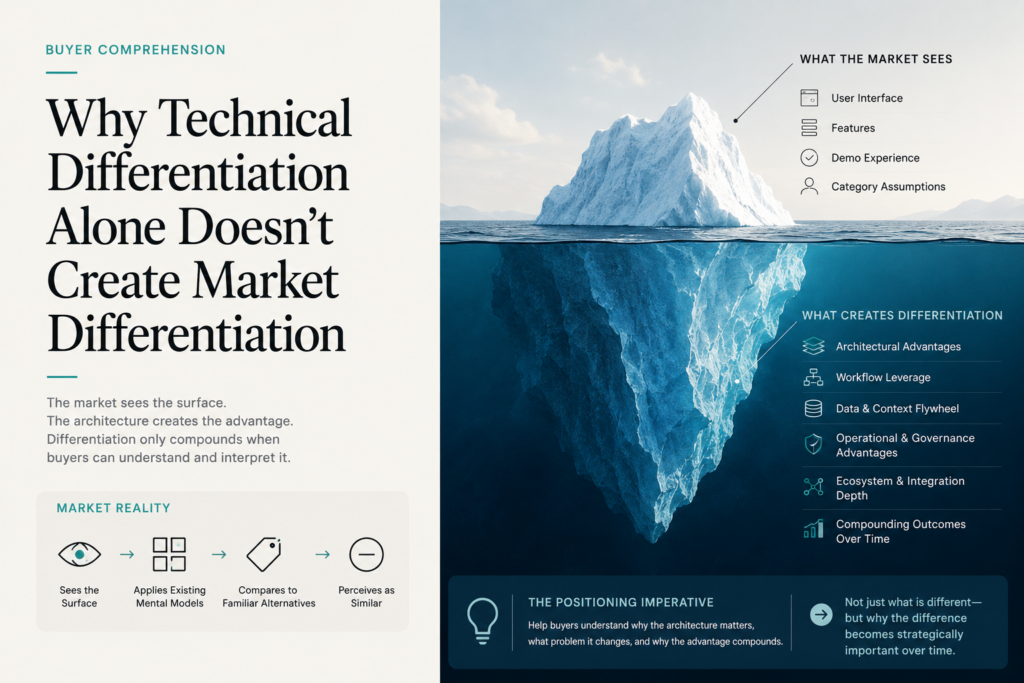
Technical Superiority Is Often Invisible
Engineering organizations frequently underestimate how much differentiation remains hidden from the market.
Many structural advantages are:
- architectural
- operational
- systemic
- workflow-level
- organizational
- or infrastructural
The buyer may never directly see them.
This creates a difficult positioning problem.
Because the company is attempting to communicate advantages that:
- emerge over time
- compound operationally
- require contextual understanding
- or only become obvious at scale
Meanwhile the market often evaluates products through:
- feature comparison
- UI similarity
- short demos
- surface workflows
- or simplified category assumptions
This creates asymmetry between:
how the company experiences differentiation
and:
how the market perceives differentiation.
That gap is strategically important.
Differentiation Must Become Interpretable
Strong positioning does not merely announce technical novelty.
It helps buyers understand:
- why the architecture matters
- what operational problem it changes
- why existing approaches break down
- and why the difference becomes meaningful over time
This is particularly important in AI markets where many products appear superficially similar while differing dramatically underneath.
As AI categories mature, many companies will discover that:
capability parity emerges faster than expected.
The products that sustain differentiation are often not the ones with isolated features.
They are the ones with:
- structural workflow embedding
- organizational integration
- proprietary context
- accumulated operational leverage
- governance advantages
- ecosystem positioning
- or infrastructure-level defensibility
Those forms of differentiation are harder to commoditize.
But they are also harder to explain.
Markets Reward Understandable Differentiation
One of the reasons many technically strong products struggle commercially is that differentiation only compounds once the market can consistently recognize it.
This requires more than:
- technical superiority
- architectural depth
- or novel implementation
It requires interpretability.
Buyers must be able to answer:
- Why is this meaningfully different?
- Why does the architecture matter?
- What problem becomes easier to solve?
- Why won’t existing approaches scale the same way?
- Why is this difficult to substitute?
Until those answers become clear, markets tend to flatten products into broader category assumptions.
That flattening creates commoditization pressure long before capability parity actually exists.
The Goal Is Not Novelty. It Is Durable Interpretation.
Many companies over-optimize for appearing innovative.
But markets do not sustain differentiation simply because something is new.
They sustain differentiation when:
- the advantage is real
- the operational value compounds
- the architecture meaningfully changes outcomes
- and buyers can repeatedly understand why the distinction matters
This is why technical differentiation alone is insufficient.
Because markets rarely reward complexity they cannot comfortably interpret.
The strongest positioning helps buyers understand not only:
what is different
but:
why the difference becomes strategically important over time.