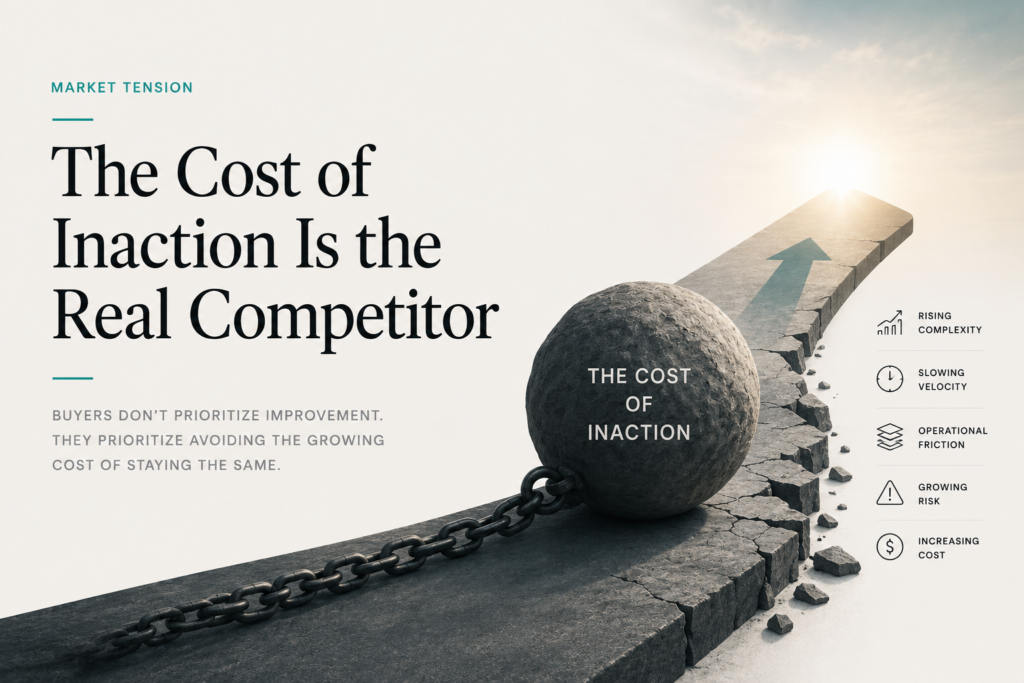
Most companies think they compete against other vendors.
In reality, the strongest competitor in most markets is usually:
the existing state.
Not because buyers love it.
But because organizations are remarkably capable of tolerating friction for long periods of time.
This is one of the most misunderstood dynamics in positioning.
Companies often assume that if a product is:
- faster
- more intelligent
- more scalable
- more elegant
- or more technically advanced
then adoption should follow naturally.
But buyers rarely compare:
your product versus another product.
More often, they compare:
your product versus the operational pain of changing at all.
That is a very different equation.
Organizations Absorb More Friction Than Expected
Most operational systems degrade gradually.
Workflows become slower.
Coordination becomes harder.
Technical debt accumulates.
Visibility declines.
Processes fragment.
Complexity increases.
But because the deterioration happens incrementally, organizations normalize the friction over time.
People adapt.
They create:
- manual workarounds
- compensating processes
- institutional habits
- duplicated systems
- escalation layers
- approval structures
- spreadsheet glue
- organizational shortcuts
Entire operating models emerge around tolerating inefficiency.
This is why many products struggle despite solving real problems.
The organization has not yet concluded that the current state is intolerable enough to justify disruption.
Change Introduces Its Own Risk
Positioning often assumes buyers are optimizing purely for improvement.
In practice, buyers are usually balancing:
- potential upside
against: - transition risk
Every meaningful change introduces uncertainty:
- migration cost
- workflow disruption
- retraining
- political friction
- implementation complexity
- budget exposure
- integration risk
- organizational resistance
This means the market does not evaluate products in isolation.
It evaluates whether the future pain of staying the same exceeds the immediate pain of changing.
That threshold is incredibly important.
Because many categories only accelerate once the consequences of inaction become more dangerous than the disruption of adoption itself.
This Is Why Pressure Must Become Visible
One reason positioning frequently fails is that companies describe benefits before the market fully understands the cost of the current state.
As a result:
- the solution sounds optional
- the category feels premature
- the urgency appears abstract
- and buyers defer action
Strong positioning often works differently.
Instead of beginning with:
“Here is what the product does.”
it begins with:
“Here is what becomes increasingly difficult if nothing changes.”
That shift reframes the market entirely.
Because organizations rarely prioritize based on theoretical improvement alone.
They prioritize based on accumulated operational consequence.
AI Markets Are Accelerating Because Inaction Is Becoming Riskier
This dynamic is especially visible in enterprise AI.
Early AI adoption was often driven by experimentation, curiosity, or executive excitement.
But increasingly, organizations are beginning to experience structural pressure:
- rising software complexity
- growing coordination overhead
- increasing delivery expectations
- scaling governance requirements
- fragmented knowledge systems
- rising operational cost
- competitive acceleration
As these pressures compound, the cost of maintaining existing operating models rises alongside them.
This changes how AI products are evaluated.
The conversation gradually shifts from:
“Should we adopt this?”
toward:
“What happens if we do not?”
That is a major market transition.
Because categories become durable once inaction starts feeling strategically dangerous.
Positioning Works Best When Consequences Are Legible
One of the most important functions of positioning is making hidden consequences visible.
Not through fear-based messaging.
But through clarity.
Strong positioning helps organizations recognize:
- where friction is accumulating
- where workflows are degrading
- where complexity is compounding
- where coordination is slowing
- where existing systems no longer scale coherently
- and where future risk is quietly expanding beneath the surface
That recognition changes buyer behavior.
Because once organizations internalize the true cost of maintaining the current state, urgency no longer needs to be artificially manufactured.
It emerges naturally.
The Market Moves When Staying Still Becomes Harder
The strongest positioning rarely persuades buyers to care about entirely new problems.
More often, it reveals:
- pressures already building
- risks already growing
- complexity already compounding
- and operational consequences already becoming difficult to absorb
That is why the real competitor in most markets is not another vendor.
It is the perceived tolerability of the current state.
Markets accelerate when that tolerability collapses.
And positioning becomes powerful when it helps organizations recognize that moment clearly before everyone else does.