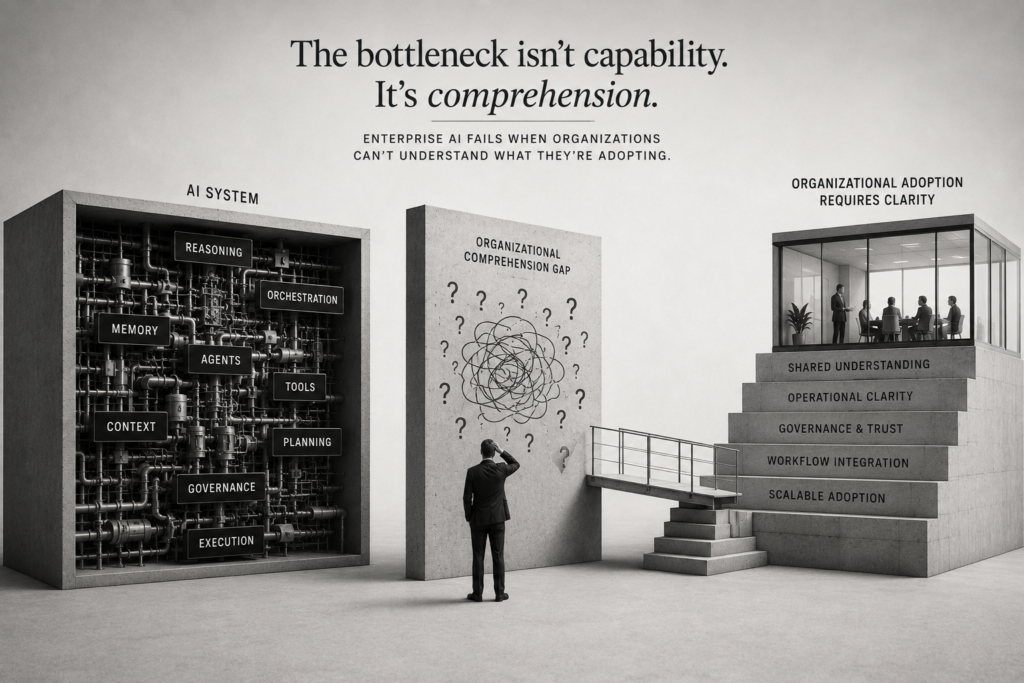
Most discussions about enterprise AI focus on capability.
How intelligent the models are.
How autonomous the agents are.
How much automation becomes possible.
How quickly software development accelerates.
But many AI initiatives fail long before capability becomes the limiting factor.
They fail because organizations struggle to understand:
- what the system actually is
- where it fits
- how it should be operationalized
- what risks it introduces
- who owns it
- and how to reason about it internally
In other words:
the bottleneck is often comprehension.
Not intelligence.
Capability Is Advancing Faster Than Organizational Understanding
Modern AI systems are evolving unusually quickly.
Architectures now span:
- agents
- orchestration layers
- reasoning systems
- workflow automation
- organizational memory
- retrieval systems
- governance infrastructure
- execution environments
- planning systems
- context layers
- coordination frameworks
But organizations are still trying to interpret these systems using older mental models:
- software tools
- assistants
- automation platforms
- chat interfaces
- productivity software
- workflow engines
This creates conceptual instability.
The technology changes faster than the organization’s ability to:
- classify it
- operationalize it
- govern it
- and align around it internally
That gap is becoming one of the defining problems in enterprise AI adoption.
Most Organizations Do Not Yet Have Stable AI Mental Models
One reason AI adoption feels uneven is that many organizations still lack stable conceptual frameworks for understanding:
- what AI systems actually are
- where responsibility lives
- how trust should work
- what governance means operationally
- and how these systems integrate into existing organizational structures
This creates fragmentation.
Different stakeholders interpret the same system differently:
- engineering sees infrastructure
- leadership sees productivity
- security sees risk
- procurement sees software spend
- operations sees workflow change
- legal sees uncertainty
- users see interface behavior
The result is organizational incoherence.
Even when the underlying technology is strong.
AI Products Frequently Get Explained Backward
One of the most common positioning failures in enterprise AI is starting with:
- the model
- the interface
- the capability
- or the automation
instead of:
- the organizational system
- the operational pressure
- or the workflow transformation
This creates shallow comprehension.
Buyers may understand:
what the system does
without understanding:
how the system changes operational behavior.
That distinction matters enormously.
Because enterprise adoption rarely succeeds through capability alone.
Organizations need:
- governance clarity
- operational clarity
- workflow clarity
- ownership clarity
- coordination clarity
- and trust models that scale organizationally
Without those things, even impressive AI systems often remain trapped at:
- experimentation
- isolated usage
- departmental pilots
- or executive curiosity
rather than becoming embedded operational infrastructure.
Enterprises Need Interpretive Stability Before They Scale Adoption
Organizations scale systems they can reason about coherently.
That requires more than technical performance.
It requires:
- stable language
- understandable workflows
- governance models
- operational predictability
- trust boundaries
- role clarity
- and organizational alignment
This is one reason many enterprises move slower than the underlying technology curve.
Not because they fail to recognize AI’s potential.
But because large organizations optimize heavily around:
interpretive stability.
Systems that are poorly understood create:
- coordination friction
- political resistance
- governance uncertainty
- operational hesitation
- and organizational distrust
Those forces slow adoption dramatically.
Comprehension Is an Organizational Problem, Not Just a Messaging Problem
Many companies treat buyer comprehension as:
a marketing issue.
But in enterprise AI, comprehension increasingly affects:
- governance
- deployment
- procurement
- operational integration
- security
- workflow design
- executive alignment
- and organizational trust
This makes comprehension structurally important.
If organizations cannot clearly explain:
- what the system is
- how it behaves
- where responsibility exists
- what boundaries matter
- and why the architecture is trustworthy
adoption friction remains high regardless of technical capability.
This is why many enterprise AI systems experience a strange pattern:
- strong demos
- high executive excitement
- meaningful pilot success
- but slow operational expansion
The bottleneck is often organizational understanding.
The Next Phase of Enterprise AI Is About Operational Legibility
Early AI adoption was driven largely by novelty and experimentation.
The next phase will likely depend far more heavily on:
- organizational clarity
- governance infrastructure
- interpretability
- operational trust
- workflow integration
- and system-level comprehension
In other words:
enterprises will increasingly favor AI systems they can reason about operationally.
Not just systems that appear intelligent.
This is a major market shift.
Because it means the companies that win long term may not simply be the ones building the most advanced models.
They may be the ones building:
- the clearest operational frameworks
- the most understandable governance systems
- the strongest trust architectures
- and the most organizationally legible AI environments
Enterprise AI Is Ultimately a Coordination Problem
One of the deepest misunderstandings in AI markets is assuming the primary challenge is model intelligence.
In reality, large-scale enterprise adoption depends heavily on:
- organizational coordination
- trust distribution
- workflow integration
- governance alignment
- operational visibility
- and shared interpretive understanding
Those are comprehension problems.
Not merely technical problems.
This is why buyer comprehension is becoming such an important strategic variable in enterprise AI.
Because organizations do not scale systems they cannot collectively understand.
And increasingly, the companies that reduce interpretive friction may gain as much advantage as the companies increasing raw capability itself.