From the outside, market adoption often looks irrational.
Some industries move aggressively toward change while others remain stagnant for years despite having access to the same technology, the same vendors, and often the same information.
One company reorganizes around an emerging category almost immediately.
Another waits until the category is already mature.
This is usually explained through:
- innovation culture
- executive vision
- technical maturity
- budget availability
- or organizational conservatism
Sometimes those things matter.
But they do not fully explain why certain markets suddenly accelerate while others remain inert.
A more useful lens is:
tension density.
Not All Pressure Is Equal
Most organizations operate with some degree of friction.
That friction is normal.
Teams tolerate:
- inefficiency
- technical debt
- fragmented workflows
- communication overhead
- duplicated effort
- governance gaps
- operational uncertainty
for surprisingly long periods of time.
The existence of a problem alone rarely creates movement.
What matters is:
how concentrated the consequences become.
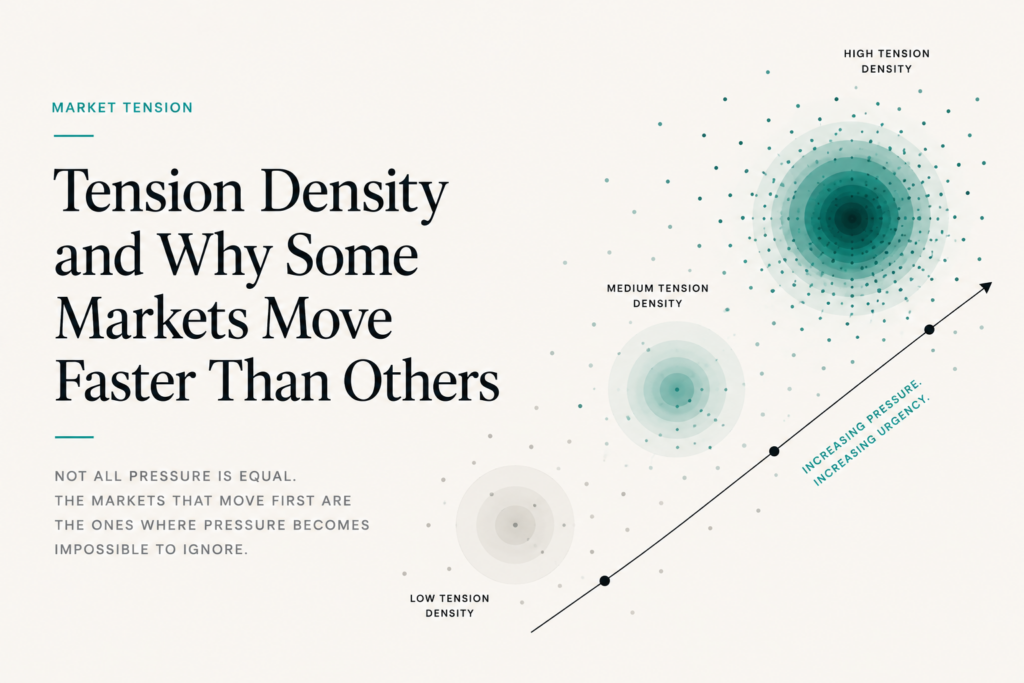
Tension density refers to the accumulation and concentration of operational, strategic, organizational, or economic pressure inside a system.
The denser the pressure becomes:
- the harder it is to defer
- the more visible the consequences become
- and the more urgently organizations seek resolution
This is why some markets move faster than others.
Not because they discovered better messaging.
Because the pressure became harder to absorb.
Markets Accelerate When Friction Starts Compounding
Many operational problems remain manageable until scale changes the economics of tolerating them.
A workflow that works for:
- 20 engineers
- 3 products
- or one business unit
may begin collapsing under:
- 2,000 engineers
- distributed teams
- AI-assisted development
- governance requirements
- compliance pressure
- or increasing system complexity
At small scale, the friction feels annoying.
At large scale, it becomes structural.
This is often the moment when categories suddenly gain momentum.
Not because the technology became dramatically better overnight.
But because the consequences of maintaining the current state started compounding faster than the organization could comfortably absorb.
Pressure reached critical density.
The Market Rarely Moves All At Once
One reason emerging markets feel confusing is that tension density is rarely distributed evenly.
Different organizations experience:
- different scaling curves
- different regulatory environments
- different workflow complexity
- different coordination overhead
- different operational constraints
This creates uneven adoption behavior.
Some organizations experience pressure years earlier than others.
Those companies often appear visionary from the outside.
But many early adopters are not reacting to abstract innovation.
They are reacting to concentrated operational necessity.
This is particularly visible in enterprise AI markets.
The companies moving fastest are often not the ones most excited about AI conceptually.
They are the ones where:
- software complexity is escalating
- delivery expectations are increasing
- governance overhead is growing
- coordination costs are rising
- and existing systems are becoming difficult to scale coherently
The pressure environment matures before the category stabilizes.
Categories Form Around Shared Pressure
Most new categories begin fragmented.
Different buyers describe the same underlying problem differently because the market has not yet developed stable language around the pressure itself.
Over time, however, tension starts becoming collectively recognized.
Organizations begin noticing similar operational patterns:
- slowing velocity
- rising complexity
- increasing coordination cost
- workflow fragmentation
- loss of visibility
- governance failures
- scaling bottlenecks
Once pressure becomes socially legible across the market:
- budgets appear
- categories stabilize
- analyst coverage increases
- executive alignment improves
- and adoption accelerates
This is one reason timing matters so much in positioning.
Markets often do not become active when products become available.
They become active when pressure becomes shared.
Strong Positioning Aligns With Pressure Density
Many positioning strategies fail because they optimize for theoretical market size rather than pressure concentration.
But large markets with diffuse tension often produce weak urgency.
Smaller environments with dense operational pressure frequently move much faster.
Because the cost of inaction is already visible internally.
This changes how positioning should work.
Instead of asking:
“How large is the market?”
companies should also ask:
“Where is pressure accumulating fastest?”
That question usually reveals:
- where urgency already exists
- where buyer behavior is changing
- where organizational tolerance is collapsing
- and where positioning can align naturally with reality instead of attempting to manufacture momentum artificially
Because markets rarely move because messaging becomes more persuasive.
They move because pressure eventually becomes impossible to comfortably ignore.