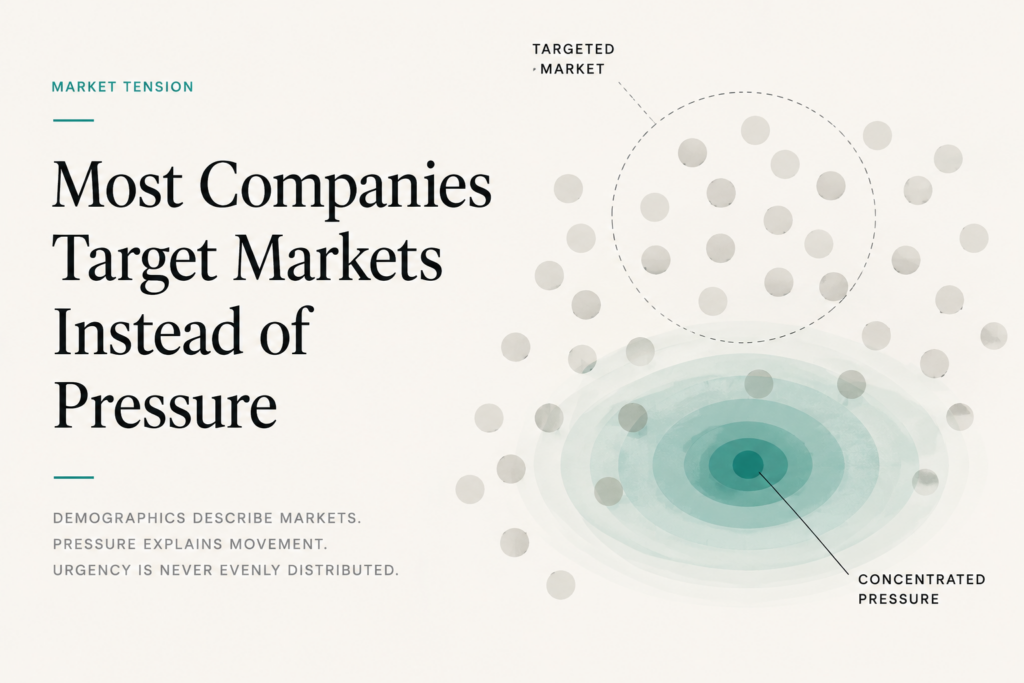
One of the most common mistakes in positioning is assuming the market itself explains urgency.
Companies define:
- industry
- employee count
- revenue band
- geography
- buyer persona
- department
- technology stack
Then build positioning around those categories as though they automatically predict demand.
But markets are not homogeneous environments.
They are pressure environments.
And pressure distributes unevenly.
Two companies can appear nearly identical on paper while behaving completely differently in practice.
One may tolerate the problem indefinitely.
The other may already be reorganizing around it.
The difference is rarely demographics alone.
The difference is usually pressure concentration.
Firmographics Explain Less Than Most Teams Think
Modern go-to-market systems are heavily optimized around segmentation.
This makes sense operationally. Companies need ways to:
- prioritize accounts
- define territories
- allocate spend
- build targeting systems
- model pipeline
The problem is that segmentation often becomes mistaken for urgency itself.
A company being:
- enterprise-sized
- in fintech
- hiring developers
- adopting AI
- or growing quickly
does not necessarily mean the underlying pressure is high enough to force change.
Many organizations continue operating with:
- fragmented workflows
- technical debt
- inefficient systems
- governance gaps
- poor coordination
- duplicated effort
- weak tooling
for years.
Not because the problems are invisible.
But because the consequences have not yet concentrated enough internally.
That distinction matters enormously.
Because positioning tends to fail when it targets broad demographics instead of environments where pressure has become operationally unavoidable.
The Real Question Is: What Happens If Nothing Changes?
Most positioning focuses on:
“Why our solution is valuable.”
Stronger positioning often focuses on:
“What becomes increasingly difficult if the current state persists?”
That shift changes everything.
Because buyers rarely move because a product is theoretically better.
They move because the cost of maintaining the current state starts compounding faster than the cost of change.
Pressure accumulates when:
- workflows stop scaling
- coordination overhead increases
- systems become harder to reason about
- operational complexity expands
- compliance risk rises
- reliability declines
- engineering velocity slows
- AI output becomes difficult to govern
- or teams lose confidence in existing processes
At some point, the organization no longer experiences the issue as background inefficiency.
It becomes a strategic constraint.
That is usually when positioning starts resonating more naturally.
This Is Why Emerging Markets Look Uneven
In early-stage categories, adoption curves often appear inconsistent from the outside.
Some organizations move aggressively.
Others remain skeptical for years.
This is often interpreted as:
- innovation appetite
- executive vision
- culture
- or technical sophistication
Sometimes those factors matter.
But many early adopters are simply experiencing more concentrated operational pressure than the rest of the market.
This is particularly visible in AI markets right now.
The organizations moving fastest are often not the ones most excited about AI conceptually.
They are the ones:
- experiencing the greatest scaling pressure
- dealing with growing complexity
- struggling with coordination
- facing rising software delivery expectations
- or encountering operational bottlenecks existing systems can no longer absorb efficiently
The pressure environment matures before the category language does.
That is why positioning frequently feels confusing early in emerging markets.
The urgency is real.
But unevenly distributed.
Markets Become Active When Pressure Becomes Shared
One of the reasons categories suddenly accelerate is that pressure eventually becomes more broadly visible across the market.
What begins as isolated operational friction slowly evolves into:
- recognized industry pain
- strategic vulnerability
- organizational expectation
- or competitive necessity
Once pressure becomes socially legible, buyer behavior changes quickly.
This is often the moment when:
- new categories stabilize
- budgets appear
- leadership alignment improves
- adoption accelerates
- and positioning becomes dramatically easier
Not because the messaging improved.
But because the pressure became collectively recognizable.
In many markets, positioning effectiveness is downstream from pressure visibility.
Positioning Is Strongest Where Pressure Is Concentrated
The instinct in positioning is often to maximize total addressable market.
But broad markets with weak tension frequently produce weak positioning.
Smaller environments with concentrated pressure often produce far stronger adoption behavior.
Because urgency already exists.
The best positioning does not attempt to convince the market a problem matters.
It identifies where the consequences of the problem are already becoming difficult to tolerate.
That is a fundamentally different strategic posture.
It shifts positioning away from:
- abstract value claims
- generalized messaging
- demographic assumptions
and toward:
- operational reality
- organizational friction
- strategic pressure
- and environments where change already feels necessary
That is where positioning stops sounding persuasive and starts feeling obvious.