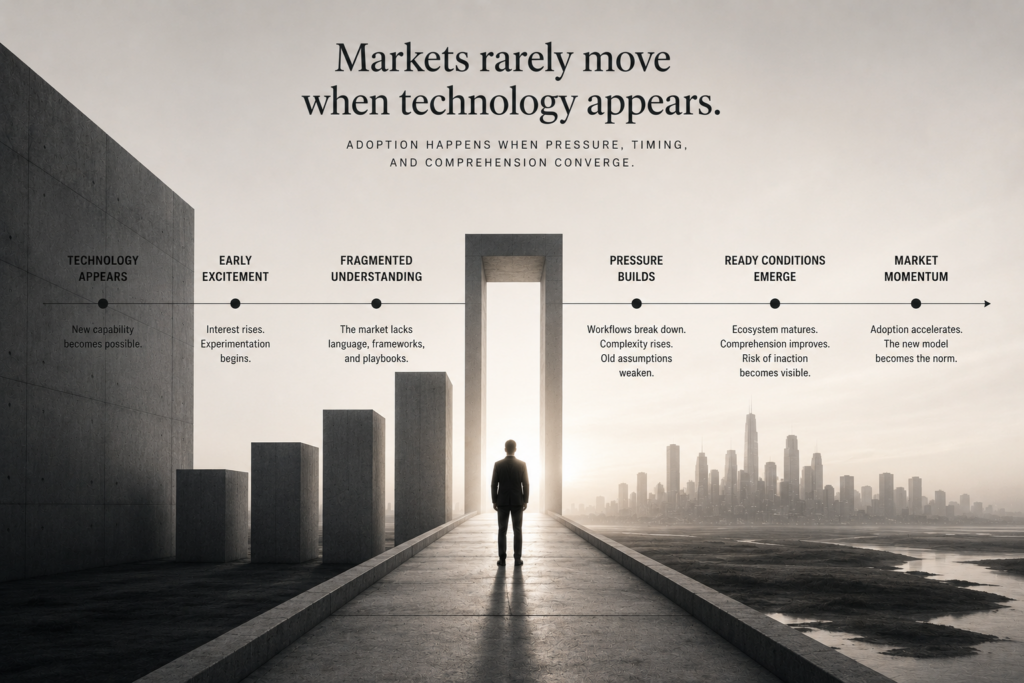
One of the most common mistakes in emerging markets is assuming that technological availability automatically creates market readiness.
It does not.
New technologies appear constantly.
Very few become immediately operationalized at scale.
This creates a recurring pattern:
- the technology arrives first
- excitement follows
- experimentation increases
- early adopters emerge
- but broad market behavior changes much more slowly
Because markets do not move simply because something becomes possible.
They move when:
- organizational pressure accumulates
- workflows become unstable
- operational assumptions break down
- buyer comprehension matures
- and the surrounding ecosystem becomes capable of supporting adoption coherently
Technology is only one variable inside a much larger transition.
Capability Alone Rarely Changes Organizational Behavior
Many technically sophisticated products fail because companies mistake:
technical possibility
for:
organizational readiness.
A capability may be:
- genuinely valuable
- architecturally important
- operationally transformative
- or directionally inevitable
and still fail to achieve meaningful adoption initially.
Why?
Because organizations optimize for:
- stability
- predictability
- coordination
- governance
- and operational coherence
not simply capability expansion.
Large-scale market transitions require much more than technical advancement.
They require shifts in:
- incentives
- workflows
- organizational trust
- governance models
- procurement logic
- operational understanding
- and shared mental frameworks
Those systems evolve slower than the technology itself.
Most Emerging Markets Exist Before They Become Legible
One of the strange characteristics of emerging categories is that the underlying market transition is often already happening long before the category stabilizes socially.
Pressure begins accumulating underneath the surface:
- workflows degrade
- coordination becomes harder
- operational complexity rises
- existing systems stop scaling cleanly
- organizational friction compounds
But the market may still lack:
- stable language
- category consensus
- operational playbooks
- shared assumptions
- and buyer comprehension
This creates a period where:
the problem is real,
the pressure is growing,
but the market still appears fragmented and uncertain externally.
Many companies misread this stage entirely.
They assume the market does not exist because the category does not yet look mature.
In reality:
the market often exists operationally before it exists conceptually.
Timing Is Usually About Ecosystem Readiness
One reason markets move slower than technology curves is that adoption depends heavily on ecosystem maturity.
New systems require surrounding infrastructure:
- governance
- integrations
- workflows
- trust models
- organizational understanding
- operational standards
- purchasing logic
- implementation knowledge
- and internal champions
Without those things, even strong technology struggles to scale beyond experimentation.
This is especially visible in enterprise AI.
The underlying capability curve is moving extremely quickly.
But organizational systems are still adapting:
- governance frameworks
- operational trust
- deployment models
- ownership structures
- workflow integration
- compliance expectations
- and interpretive understanding
The result is a market that feels simultaneously:
- early
and: - inevitable.
That tension defines many important technological transitions.
Markets Move When Multiple Conditions Converge
Large category shifts usually happen when several forces begin aligning simultaneously:
- pressure becomes visible
- older systems weaken
- buyer comprehension improves
- operational risk increases
- ecosystem infrastructure matures
- and organizational incentives start changing together
This creates inflection points.
From the outside, these transitions often appear sudden.
But most “sudden” market shifts are actually the visible release of pressure that accumulated gradually over time.
The technology may have existed for years already.
What changed was:
the surrounding environment.
Early Markets Often Feel Contradictory
One reason emerging markets confuse companies is that timing signals frequently appear inconsistent.
The market may simultaneously show:
- intense interest
- fragmented understanding
- high experimentation
- weak operational adoption
- executive excitement
- organizational hesitation
- and unstable category language
This is normal.
Because markets rarely transition cleanly.
There is usually a long intermediate phase where:
- the old model is weakening
- the new model is emerging
- but the ecosystem has not yet fully reorganized around the transition
That ambiguity creates enormous strategic difficulty.
Especially for companies trying to determine:
- how aggressively to educate the market
- how far ahead to position
- how much novelty buyers can absorb
- and when organizational readiness will actually accelerate
Being Right Too Early Still Feels Wrong
One of the hardest realities in emerging markets is that timing affects perception itself.
A company can be:
- directionally correct
- architecturally superior
- strategically aligned with the future
and still struggle because the market has not yet developed the interpretive readiness required to understand the shift fully.
This creates one of the central tensions in strategic timing:
markets often reject ideas before they eventually normalize them.
That does not mean the thesis was incorrect.
It often means:
the surrounding ecosystem had not matured enough yet.
The Best Companies Learn to Read Transitional Signals
Strong strategic timing is rarely about predicting technology alone.
It is about recognizing:
- pressure accumulation
- ecosystem maturity
- organizational readiness
- workflow instability
- governance evolution
- buyer comprehension
- and category formation dynamics
before the transition becomes obvious broadly.
That is much harder than trend forecasting.
Because markets do not move when technology appears.
They move when organizations collectively become ready to reorganize themselves around what the technology makes possible.