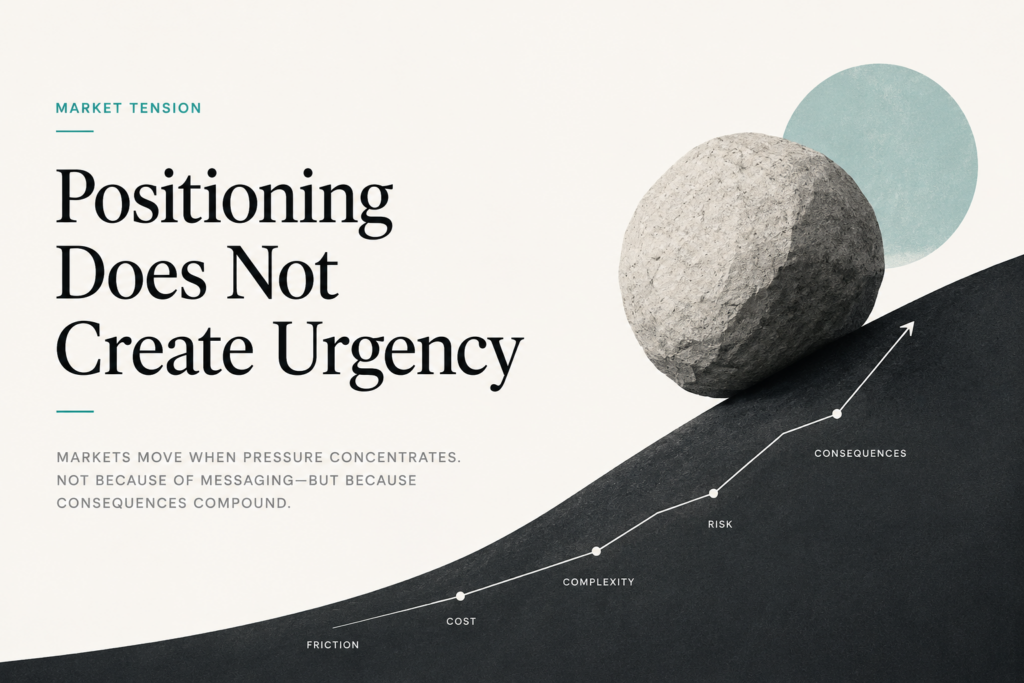
Most positioning conversations begin in the wrong place.
Companies start by asking:
- What should we say?
- How should we describe the product?
- What messaging will resonate?
But positioning alone rarely creates urgency.
At best, positioning clarifies urgency that already exists.
This distinction matters more than most companies realize.
Because many products struggle in the market not because the messaging is unclear, but because the underlying pressure inside the market is still weak, fragmented, or unevenly distributed.
No amount of positioning can fully compensate for that.
Markets Move When Pressure Concentrates
Technology adoption is often explained as a function of innovation.
In practice, markets usually move because pressure accumulates faster than existing systems can absorb it.
Organizations tolerate surprising amounts of inefficiency, fragmentation, technical debt, and operational friction for long periods of time. Most problems remain background noise until the consequences become concentrated enough that change feels unavoidable.
That pressure can take many forms:
- rising operational cost
- organizational bottlenecks
- regulatory exposure
- scaling complexity
- security risk
- workflow collapse
- competitive disadvantage
- coordination overhead
- growing uncertainty
The important point is that buyers rarely wake up searching for a category.
They wake up trying to resolve pressure.
Strong positioning aligns itself with pressure that already exists rather than attempting to manufacture urgency through messaging alone.
Most Companies Target Markets Instead of Pressure
One of the most common positioning mistakes is treating the market as a demographic construct instead of a pressure environment.
Companies define:
- company size
- industry
- job title
- budget range
- geography
But those variables often explain very little about urgency.
Two companies with identical firmographics may behave completely differently depending on how concentrated the underlying pressure has become inside the organization.
One may tolerate the problem indefinitely.
The other may already be reorganizing around it.
This is especially visible in emerging technology markets where adoption curves often appear irrational from the outside.
The companies moving first are not necessarily the most innovative.
They are often the ones experiencing the greatest operational or strategic tension.
Positioning becomes significantly stronger once companies stop asking:
“Who is the customer?”
and begin asking:
“Where is pressure becoming intolerable?”
The Market Already Knows What Hurts
A surprising amount of marketing attempts to educate buyers about problems they do not yet feel strongly enough.
This usually creates positioning that sounds theoretically compelling but commercially weak.
The strongest positioning often works differently.
Instead of introducing entirely new pain, it:
- clarifies existing tension
- names operational friction
- organizes scattered anxiety
- explains why existing approaches are beginning to fail
- and provides a coherent interpretation of what buyers are already experiencing
In many cases, the market already understands the symptoms before it understands the category.
The role of positioning is not necessarily to invent the problem.
It is to make the pressure legible.
This Is Why Timing Matters
Urgency is not static.
Pressure accumulates unevenly across markets.
A problem that feels optional today may become strategically unavoidable eighteen months later because:
- scale changes
- infrastructure matures
- regulation shifts
- workflows evolve
- organizational complexity increases
- or the economic environment tightens
This is one reason positioning can appear ineffective early in a category and suddenly become obvious later.
The messaging may not have changed very much.
The pressure did.
Many products fail not because the positioning was wrong, but because the tension density inside the market had not yet concentrated enough to force prioritization.
Positioning Works Best When It Aligns With Reality
There is a tendency in marketing to treat positioning as persuasion.
But the strongest positioning often feels less like persuasion and more like recognition.
Buyers see themselves in it.
They recognize the pressure.
The friction.
The organizational cost.
The growing complexity.
The inefficiency they already feel but have not fully articulated internally.
That recognition is what creates momentum.
Not slogans.
Not category language.
Not messaging frameworks in isolation.
Positioning becomes powerful when it aligns:
- differentiated truth
- buyer comprehension
- strategic timing
- and existing market pressure
without exaggerating any of them.
That is why positioning alone does not create urgency.
At its best, it reveals urgency that was already there.